
What does 'autonomy' actually mean?
How do people experience it in their work? And what can pest control teach us about the concept?

In the film Erin Brockovich, there’s a scene early on where, intrigued by a real estate case file, Erin asks her boss, “Would you mind if I investigated this a little further?”
Her boss replies with a non-committal, ”Go ahead.” So she does.
When she comes back to the office a week later, her desk is clear and she’s being let go. She’s told, “That’s not how we work here. You don’t just leave a message and take off.”
For anyone who has watched the film, we know that this is not the end, she has not lost her job and this week away from her desk is the catalyst for an exciting legal drama.
But in real life we rarely know the consequences of our actions before we take them. How many organisations would allow you to disappear for a week and trust that it’s for a good reason?
This question is less about absolutes and more about boundaries, about the limits put upon your choices in the workplace, and how well these are understood by both you and your manager. This question is really about autonomy.

What does autonomy mean?
“Autonomy: the urge to direct our own lives.”
Daniel Pink, Drive: The Surprising Truth About What Motivates
There are some words that lose crucial meaning when substituted for something else.
For example, if you’re ‘hangry’ you aren’t simply irritable, you are in a voracious hole of frustration and need, and probably other things too.
Autonomy is one of these words. In a professional setting, autonomy means several things:
having genuine authority to make decisions
being trusted in the decisions you make
having the freedom to choose when, how and where you do your job.
Other words that get used are ‘discretion’ and ‘independence’.
Professional autonomy goes one step further as it recognises the specialism and expertise within which you exercise your autonomy. For example, your safeguarding lead is the one who decides whether to make a referral not you, it is their responsibility and reflective of their training and expertise.
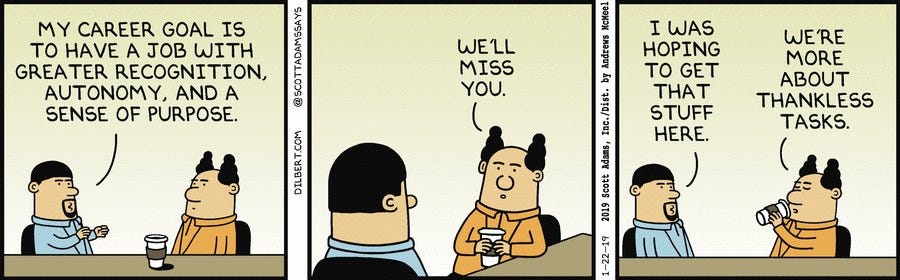
At its heart, autonomy represents how you feel: about yourself as a professional, the decisions you’re trusted to make, and the boundaries within which you’re allowed to operate in your work.
Why does autonomy matter?
“Those three things - autonomy, complexity, and a connection between effort and reward - are, most people will agree, the three qualities that work has to have if it is to be satisfying.”
Malcolm Gladwell, Outliers: The Story of Success
For those who enjoy the “so what” of psychological constructs, autonomy is a strong motivator for people to enjoy and thrive in their jobs. This is something my own research revealed: that autonomy was the strongest factor affecting job satisfaction among fundraisers.
If your people feel like they have autonomy over their work, they are more likely to do that work well.
This doesn’t mean that they have free rein to do whatever they want.
A key part of professional autonomy is exercising your expertise. That means the boundaries of someone’s autonomy should reflect their level of confidence and skills.
In a situation where someone is trusted to make decisions where they don’t trust themselves, that’s not autonomy, it’s irresponsible!
Equally, it should be expected that as someone develops in their role, as they become more expert, the level of trust and discretion to do their job increases.
Learning from pest control
There’s some fascinating new research from Hannah Fair that explores why professional pest controllers really enjoy their jobs. It’s not a career that would usually spring to mind when thinking about job satisfaction, in fact it’s usually lumped in with the concept of ‘dirty work’: tasks or jobs that society perceives as degrading, disgusting, or morally questionable.
Dr Fair identifies two different aspects of autonomy at play. The first is the more conventional: a pest controller is literally in control of how they do the job.
Pest controllers also tend to experience a relatively large amount of freedom and autonomy over how and when they work, both as sole contractors and as employees of larger companies.
Dr Hannah Fair, The Conversation
The second is what the author terms ‘dialectical autonomy’: the autonomy of rats to try and survive interplays with the professional rat catcher’s choices of how to catch them and how to do it humanely. Rats are adaptable, and so rat catchers must exercise creativity to catch them.
There are three aspects to this that I think the for-purpose sector could learn from:
1. Not undervaluing those engaged in ‘dirty work’
The phrase is purposefully provocative; no one wants to be dirty. But in our sector there are certain roles that share traits with other types of ‘dirty work’, one of which is low professional status.
It could be argued that many at the frontline of delivery in our sector are least well paid, and yet it is most often this kind of work that is at the heart of whether we truly serve our purpose.
There’s a related concept of ‘courtesy stigma’: stigma transferred to a worker not because of what they do, but because of who they work with.
I believe there is a double-edged sword, where the general public may appreciate people who “work for charity” but be more wary of those who work directly with service users, particularly as so many are stigmatised - too many to list here.
2. Setting - and re-setting - clear boundaries for decision-making
This is the foundational work between employee and employer that sets up whether someone feels like they have autonomy. And which ideally builds over time, as expertise and trust build.
You could even use the Erin Brockovich example as a starting point! How often do I have to check in with you? Do I have to tell you when I’ve started work each day? Can I launch a campaign without your sign off? Or write a LinkedIn post without running it past you?
When it comes to autonomy, it is always better to set out the boundaries explicitly than end up in the realm of seeking forgiveness. Few things will undermine your sense of professional self more than being told off.
3. Embracing the tension of dialectical autonomy
Or in plain English: becoming more comfortable with evolving and changing how we do our jobs.
Yes, this is partly about AI (what isn’t?) but it’s also about organisations rewarding people who identify that new approaches are needed: for new problems and for the perennial ones that feel repeatedly unsolvable.

Do you feel like you have autonomy?
At its heart, the reason autonomy motivates us at work is less because we get to feel like proper adults (although it helps) and more that we get to solve problems ourselves.
Some organisations prefer process over professional autonomy. Their culture may be one of control rather than creative thinking. They may not even realise they have made this trade-off.
If this sounds familiar, then it may be worth exploring the issue with intention.
Invite the conversation with your manager; ask the questions. It is better to clarify how much authority, trust and freedom you have to do your job, the way you would like to do it, than wonder why you’re feeling frustrated.
Your Job: Love it or Leave it?
I offer a one-off session for people who feel uncertain about their role or direction, helping you step back and make sense of where you are. This includes the extent to which autonomy - or lack of - may be impacting how you feel about your job.
Find out more, including how to book a session, on my website: https://peoplepurpose.co.uk/your-job-love-it-or-leave-it