
Toxic for whom?
What feels damaging for some may be a place others thrive. Here's a few theories that help explain these different experiences.

In my work as a skills coach for apprentices, I get a glimpse into a fascinating variety of different workplaces. Last year I had a learner at a software company. Their company principles include a “Relentless focus on results” as well as the line, “Don’t let perfection get in the way of progress.”
The word ‘relentless’ reflected most honestly the culture I perceived. This is a company that expects their people to put in the extra hours, to demonstrate almost ruthless ambition. My learner’s line manager had worked there for years and loved it. He fully embraced the high pressure, high stakes ethos of the organisation.
He was unapologetic about it. Not that I would have asked him to apologise! It came across that the “go hard or go home” mentality was expressed openly within the company. This is who we are. We are relentless and we seek progress over perfection.
For some people this would be a nightmare. For others this is exactly the kind of workplace where they will thrive.
Somewhere that lets them try things without having to put a proposal together first, which is then reviewed by their manager, then the leadership team, with a mandate to make some changes and provide it in a different format. At which point it’s been 4 months and what started with enthusiasm has been drowned in bureaucracy.
Would it surprise you if this hypothetical organisation with all the layers of sign off describes itself as "innovative”? Probably not.
Evolution of culture
In the 1980s, the psychologist Benjamin Schneider proposed a model that explained how and why organisations can feel so different from each other, despite so many of them using similar software, management tools and organisational structures.
He called it the attraction-selection-attrition (ASA) model.
People are attracted to certain types of organisation,
the organisation then selects people that match their preferred type of person,
and finally people who don’t really fit the organisation leave, or follow the attrition process.
The inevitable outcome is that the organisation becomes more homogeneous, with the people who remain being those that both suit and shape the prevailing culture.
Schneider and his associates proposed that this ‘homogeneity hypothesis’ would ultimately result in dysfunction, as organisations become ingrown and resistant to change (Schneider et al. 1995).
This dysfunction, however, is likely in the eye of the beholder.
For the people who embrace the organisation’s ways, those who dissent - and eventually leave - are not speaking sense to power, they are a fly in the ointment.
For the person dissenting, this can be a thoroughly unpleasant experience. Especially because they will have been attracted to the organisation in the first place and likely excited to have been selected to join.
In a sector like ours - where pro-social motivation and intrinsic values play a greater role - it can be that much more damaging when the lived experience of an organisation does not live up to its promise.
What makes somewhere toxic?
A few weeks ago I wrote a LinkedIn post about toxic cultures in charities.
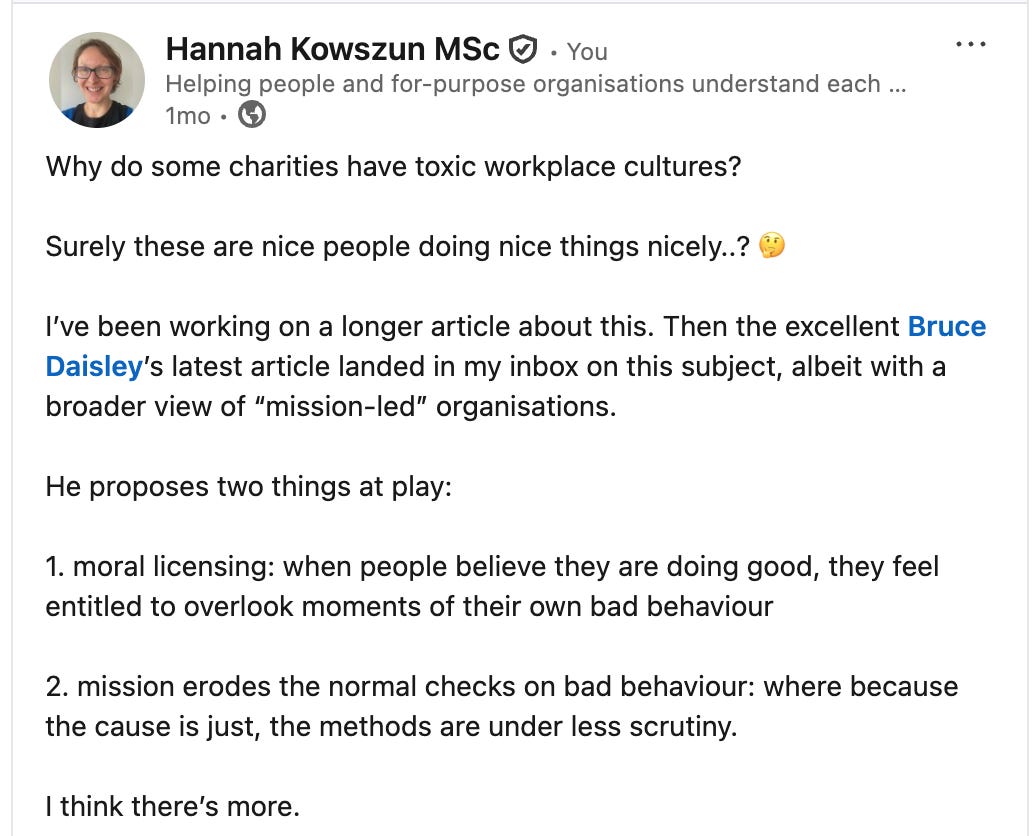
It got a lot of response, with a fair number of people messaging me directly.
There is little peer-reviewed research into the subject of toxic culture within charities and nonprofits specifically. There is more about toxic workplaces more generally.
In 2007, academics Padilla, Hogan, and Kaiser proposed a framework called the Toxic Triangle, to try and explain how and why a workplace can be - and remain - toxic even after particularly noxious individuals leave.
The triangle is composed of three interconnected factors:
Destructive leaders (those who love power, coercion and may be so charming people don’t realise!)
Susceptible followers - both colluders (alignment with the leader to share in benefits) and conformers (compliance as a safety mechanism)
Conducive environment (conditions that allow destructive leadership to thrive)
The dependency of these factors means that changing one may not lead to change overall.
The narcissistic CEO might leave, but their weak and ineffective Board and susceptible followers remain.
It is the system at play which is important.
Working alongside those who choose to quietly comply can be particularly despairing. You know they’re as unhappy as you are, but instead of having your back when you try to speak up, they put their heads down.
Many of the people who contacted me were in a system like this, where they didn’t have enough influence to change anything and had come to the conclusion there was too much that needed to change.
Spare a thought for the person who replaces a destructive leader in this situation: the compliant followers desperate for something better but too cowed to be part of the solution, the colluding followers who miss their power and aren’t sure how to play this new leader, and the environment that hasn’t (yet) changed, which holds the new leader back from making a positive turnaround for the organisation.
Differential experiences
In a situation like the ASA model, where the prevailing culture is one that is simply too entrenched to change, it is the people who recognise a desperate need for change that experience toxicity.
In a homogeneous organisation, being the sole representative of difference may not feel safe. Having the courage to suggest there should be even more representatives of difference feels even less safe. A workplace that feels unsafe can eventually feel toxic.
Ironically, it may even be that the “toxic” person in the organisation is perceived as the dissenter! Everyone else is happy with how things are, why does this person feel the need to keep rocking the boat?
This is where campaigns like CharitySoWhite and CharitySoStraight take the role of dissenter within our wider sector: challenging our collective homogeneity and resistance to change.
How unhelpful they are! How toxic to our reputation as a sector that does good things.
In a toxic triangle, however, there are people who are emboldened by the culture.
It can be quite nice sitting on a Board where the leader tells you everything is great, the papers are always positive and meetings are a pleasant conversation between peers.
Or being a colluder: for one, no one is going to tell you you’re a colluder. This isn’t post-war Germany! The attraction of collusion is that you’re far less likely to be caught in the destructive crosshairs of the leader. You’re also more likely to get promoted, to be told you’re doing a good job.
A toxic workplace is not an objective reality for everyone.

There’s a quote from the film Rounders that has been paraphrased heavily over the years:
“If you can’t spot the sucker in your first half hour at the table, then you are the sucker.”
In this context it speaks to the risk that if you’re thriving you may assume everyone else is too.
Unfortunately, finding out that your workplace may not be a safe space for everyone means you know now, and you can’t un-know it. This is when it gets tough for you too.
The question isn’t simply whether your culture is toxic, it’s whose experience of it you’ve never thought to ask, or whose feedback you’ve actively rejected.
I suspect this is particularly pertinent for organisations that grow rapidly